Friday, July 24, 2020

Education Fees in Corona Virus Pandemic

  
COVID-19: Schools, parents still fight over fee payment, denial of access to online classes
When schools decided to move classes online in April 2020 in the wake of the Coronavirus outbreak, Parthiv Gupta had no inkling that things would worsen over the next few weeks.
Gupta, who is at a mid-level position at an advertising firm in Indore, had to take a 50 percent pay cut from May onwards. Even as he was trying to calculate how to manage his finances, his son’s school sought the full-year fee of Rs 2 lakh within a week.
Since there was a delay in payment, Gupta’s son was locked out of the class more than four times. In fact, once the teacher even sought clarification from the 11-year-old about when his parents would pay the fee.
Gupta, finally, borrowed some money from his relatives and settled the issue. He doesn’t want to name the school for fear of retaliation.
The story is the same across India. On one side, parents are protesting fee hikes and demanding waivers, on the other, schools are not offering special discounts, saying classes are still being held and teachers have to be given salaries.
The Union HRD ministry is yet to throw some clarity on the list of inclusions and exclusions in fee for the academic year 2020 -21. MHRD has only asked schools to be considerate and avoid fee hikes this academic year.
S Kapoor, the father of a student at Mumbai’s Oberoi International School, said that there should be a complete refund since no physical classes are held. Kapoor has paid upwards of Rs 3 lakh for this year.
“It is almost two months since the school is shut. We did get some token refund, but a proper calculation should be done and future fees adjusted,” he said.
Oberoi International School spokesperson said that the school management has deferred and staggered the schedule for the payment of tuition fees for the academic year 2020-21.
The spokesperson added that the changed schedule will have fees payable in four installments instead of the earlier two.
"We are also mindful of fees collected in the last academic year for services not rendered, and have passed  on savings in lunch fees, bus fees and fees of after-school activities to the parents," said the school.
Also Read: A lot to learn for students, teachers as school moves online
On an average, the yearly pay for a secondary school teacher would range between Rs 3.5 lakh and Rs 6 lakh. At international schools, it could even go upto Rs 35 lakh.
The parents’ side of the story
Parents of students at VIBGYOR Group of Schools want the institution to revoke the 8-10 percent fee hike and restructure it owing to salary cuts and job losses due to the pandemic.
The VIBGYOR Group spokesperson told Moneycontrol that the hike decision was taken in February 2020, when there was no pandemic.
Maninder Singh, the parent of a VIBGYOR school student in Mumbai, admitted that. Then, he argues: “This is the not the regular school hours but a shortened version. If we had agreed to the fee hike earlier, that was not for online classes. Some consideration must be given by the school.”
The Group spokesperson added: “The original timeline for payment was early April. We have subsequently revised the date several times to allow parents greater flexibility. Currently, it is August 1, 2020.”
Further, the institution has rolled out the EduBridge Scholarship Programme (a form of fee waiver) in May 2020, which provides financial assistance to salaried class parents who have been affected by pay cuts or loss of employment, he explained.
As per the spokesperson, most eligible applicants (even non-salaried parents) have been approved for this waiver and have received adjustments amounting to two-quarter fee payments, on an average (maximum of three-quarter fee waiver). The school said that it is not forcing any student to pay fees.
In another instance, Ryan International School Navi in Mumbai removed a child from online classes.
Ryan International Group spokesperson of told Moneycontrol that the institution learnt about one student who could not attend one specific class, but added that this was due to a local issue at the school and was resolved immediately.
“We have partnered with GrayQuest to provide an EMI option to parents where the entire interest cost is being borne by the school. We have activated this pilot phase with a limited set of parents now. We will extend it to the rest soon,” said the school spokesperson.
Also Read: Are schools ready to transition online?
In some cases, parents have started protests on the street, leading to police intervention.
On July 21, parents of St Andrews School in Secunderabad, clashed with the police after they attempted to stop the protest against an alleged fee hike. The police reached the spot after a complaint from the school.
The protesting parents claimed that the school management denied online class access to their children for non-payment of fees and demanded re-admission.
The school could not be reached by Moneycontrol despite repeated attempts.
State governments’ views
Several state governments like Delhi, Gujarat, Telangana, Maharashtra and West Bengal have told schools to not hike fees for the 2020-21 academic sessions. Schools have also been prohibited from removing students from online classes.
These states have also asked schools to not arbitrarily charge for expenses like library and transport and have warned of penal action.
These directives haven’t gone well across several schools. The Gujarat school education department said in a July 16 resolution that private schools can neither charge any fee nor hike tuition fee till the time physical classes don’t resume.
Self-financed private schools in the state were in a quandary and almost 12,000 schools stopped online classes.
“The government resolution is not acceptable. Aren’t we conducting online classes? Who will pay for the costs? So we have decided that all self-funded schools will stop all online classes from July 23 till the GR is withdrawn,” said the principal of a Surat-based school.
The sudden decision by the schools has left students in the lurch since the academic lessons would get hit.
Legal decision on fee payment matter
There was a perception that schools are legally prohibited from debarring students from online classes. However, the order given by Delhi High Court in a case pertaining to Queen Mary’s School, Northend, Delhi, showed that this may not be the case.
This case pertained to the school filing a case against a Delhi government circular. The Aam Aadmi Party government had, in an April 2020 circular, said that even if parents are not able to pay fees due to the COVID-19 financial crisis, no student can be denied the ID and password for getting online access.
The school, in its plea, said that taking unfair advantage of the above clause, 40 percent students are defaulting payment of tuition fee, resulting in a grave financial crisis to the school.
Justice Jayant Nath, in the July 8 order, said that where parents are defaulting tuition fee payment for more than two months, the school is ‘free to issue an appropriate notice’ to seek reasons for the delay.
In case, parents are able to convince the school about their financial inability, no action should be taken, the order said. But if the parents are unable to ‘satisfy’ the school about their financial difficulties, the school can communicate the same to the parents and decline students the ID and password.
The Delhi HC will hear the matter next in August 2020. If parents have any grievance against such an order passed by the school, they can approach the Delhi government, Justice Nath said in the order.
Cost reduction for schools due to the pandemic
While there is a belief that schools are only incurring one-fourth of the actual costs for online classes, that alone cannot be a justification for non-payment of fees.
“There seems to be a perception that schools are taking all the money and keeping it in their coffers. This is incorrect. We are incurring high costs, especially since digital infrastructure costs money,” said Kolkata-based school principal Abhijit Dwivedi.
While school infrastructure costs like electricity, administrative supply like pen/paper/stationery are saved, regular education costs of classes and conducting exams are still there, he said.
“Typically, schools incur Rs 2 crore- Rs 3 crore per annum for expenses like salaries and infrastructure. Even if electricity, water and office supplies are subtracted, we are not saving much in 2020. This is because schools across India have been forced to hire technical support for online lessons and also offer specialised training for teachers. It is a myth that we are overcharging parents during lockdown,” he added.
Queen Mary’s School, Northend, Delhi, had, in its petition, argued that the school is struggling to pay the salaries of the staff and the teachers due to non-payment of fees.
The spokesperson of Ryan International Group of Institutions said that while there are some reductions in fuel and maintenance costs, this has been more than offset because of the additional technology costs like licence costs, equipment and bandwidth.

Thursday, July 16, 2020

Coronavirus lockdown triggers rush of new retail investors into the stock markets

Coronavirus lockdown triggers rush of new retail investors into the stock markets

New investors are putting their money into options, which offer high returns but are riskier. Analysts attribute their affinity to low margin requirements and ease of executing the trade

A wave of new investors have thronged the Indian stock markets in recent months during the coronavirus lockdown, triggering a boom in retail and significant rise in trading activity.
People stuck at home are glomming onto share trading like never before. Several are bored and have money to spend. Lack of alternatives to make a quick buck —betting is still not legal in India—and incentives and discounts from brokerages have attracted hordes of new investors.
To be sure, this is not the first time the markets are seeing a flurry of new investors. But the lockdown has made stock market investing and the kind of new investors different from previous years.
Most brokerages have reported a rise in demat accounts. Most of the new investors are from tier-2 & 3 cities.
On July 8, Upstox, a fast-growing brokerage, said it has acquired over 1 million customers.
“Over 80 percent of the total customer base acquired by the company are from Tier-2 and Tier-3 cities like Nashik, Jaipur, Guntur, Patna, Kannur, Tiruvallur and Nainital, among others,” the brokerage said.
The market action in June confirms this trend. When Nifty rallied more than 7 percent, the market turnover rose by over 37 percent to Rs 14.6 lakh crore on a month-on-month basis.
In other words, the share of retail and high net worth investors in the markets is showing a big uptick.
Compare that to institutional participation. Institutional turnover rose by just over 9 percent to Rs 5 lakh crore in June, National Stock Exchange (NSE) showed. Overall, activity from this class of investors has been tepid so far in 2020.
“Globally, there is a trend of increasing contribution by retail investors in the cash segment of the equity markets. The experience has been the same in India too. Over the past two years, the share of retail participation has inched gradually to over 50-52% in the cash segment,” Jaideep Arora, CEO, Sharekhan by BNP Paribas told Moneycontrol.
The coronavirus lockdown has accelerated the trend, according to him because retail investors used the opportunity to invest in corrections. “Equities also attracted investor attention due to the comparatively weaker return profile of other asset classes like real estate and fixed income,” he said.
Brokerages like Upstox said the majority of the new customers are below the age of 35, mirroring a trend in overseas like the US.  But unlike in those markets, these investors are not attracted to shares like a moth to a flame. Working from home in recent months have given retail investors sufficient time to understand the nuances of share trading.
"Work from home has been definitively the opportunity for Retail and HNI Investors to study, learn about Equity, FO, Trading etc, and start investing! In addition, the falling FD rates pushed many to look at other options to make their money grow," said Arora.
Prakarsh Gagdani, CEO, 5paisa.com, a brokerage, told Moneycontrol that the retail investor has more time to read, evaluate, and understand the markets. “Besides, the massive slide during late March offered attractive valuations which created an investment frenzy. Also, most brokers offer end-to-end digital investment options and benefitted in a work-from-home scenario significantly,” he said.
The fall in markets helped. Rookie investors have been able to invest in good companies at discounted prices.
"Overall, to start investing after a market crash is a strong proof of maturity in an investor," said Arora.
This affinity for stocks is in striking contrast to what happened in 2008 when the global financial crisis hit equity markets across the globe including India.
Retail investors were the first to take a hit with equity and mutual fund portfolios depleting in double digits. Individual investors then abandoned the stock markets in hordes and it took them a couple of years to believe in share trading.
In 2020, benchmark indices fell by about 40 percent from the highs, but that did not push retail investors out of D-Street. A sign of maturity perhaps.
Nikhil Kamath of Zerodha, India’s biggest brokerage, said it is heartening to see investors invest in blue-chip large-cap stocks and mutual funds. “On Coin, our direct mutual fund platform, flows and transactions have grown 2-3X pre-COVID19 both in terms of flows and transactions.”
Maturity or not, retail participation as a percentage of total cash turnover (retail and HNI) shot up to over 80 percent in July from 76 percent in January.  Institutional participation as a share of total cash turnover fell to a little over 14 percent in July from 23 percent in January 20.

Where is the money going? 
Where are these new crop of investors putting their money? The answer is options, which offer high returns but are riskier. But analysts attribute their affinity due to low margin requirements and ease of executing the trade.
“One of the major reasons for the popularity of options trading is the reduction of margin on hedge positions by exchanges. Today it is as low as Rs 25,000 which was at least Rs 1 lakh earlier,” said Gagdani.
Kunal Saraogi, CEO, Equityrush, which offers structured short-term courses in technical analysis, derivatives, and trading, said a large number of new investors sign up for learning options trading. “We have seen a huge surge in interest in trading options over the last few months. Options, considered very complex, were up until recently a preserve of professional traders have become more accessible to a wider segment of traders in recent months.”
Saraogi said what has contributed to this change is a hike in lot sizes that have rendered futures beyond reach of a lot of traders and the advent of a new crop of young traders who are more inclined to take calculated strategic bets using options.
“This is visible in the huge jump in options volume on the bourses. I would call this democratisation of option trading as even newer smaller traders have entered a space previously out of bound for them,” he said.
Getting the right knowledge is important 
That said, making money in a stock market is not as easy as it looks or even sounds. One mistake could create a big hole in savings that would set back people many years.
A deep understanding of the markets and training are essential for investors. Brokerages Moneycontrol spoke to said they have built systems to caution customers about the risks.
Gagdani of 5paisa.com  said his company offers regular digital education on equity investing and risks associated so that investors can take informed decisions.  “We suggest them investing through ETFs, create diversified portfolios with good quality stocks and provide high-quality research services at low-cost subscription,” he said.
Markets could reach historic highs. But investors would be wise to remember the world is being ravaged by a deadly pandemic.
Disclaimer: The views and investment tips expressed by experts on Moneycontrol.com are their own and not those of the website or its management. Moneycontrol.com advises users to check with certified experts before taking any investment decisions.

Monday, July 13, 2020

Small cap and midcap

YOU ARE HERE: HomeNewsBusinessMarkets
Last Updated : Jul 14, 2020 10:00 AM IST | Source: Moneycontrol.com

FoMo or value buying? Smallcaps make quick recovery from March 24; 123 stocks rise over 100%

The BSE Smallcap index has rallied about 44 percent and the BSE Midcap index 35 percent since March 24. The Sensex has risen 37 percent and the Nifty 38 percent during the period.


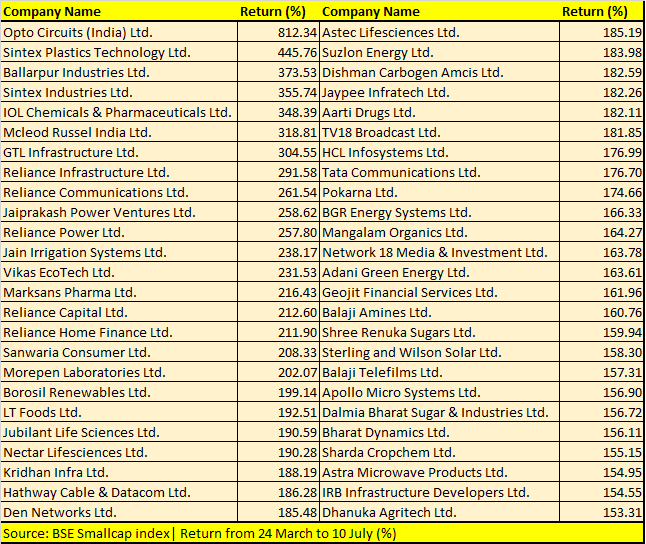
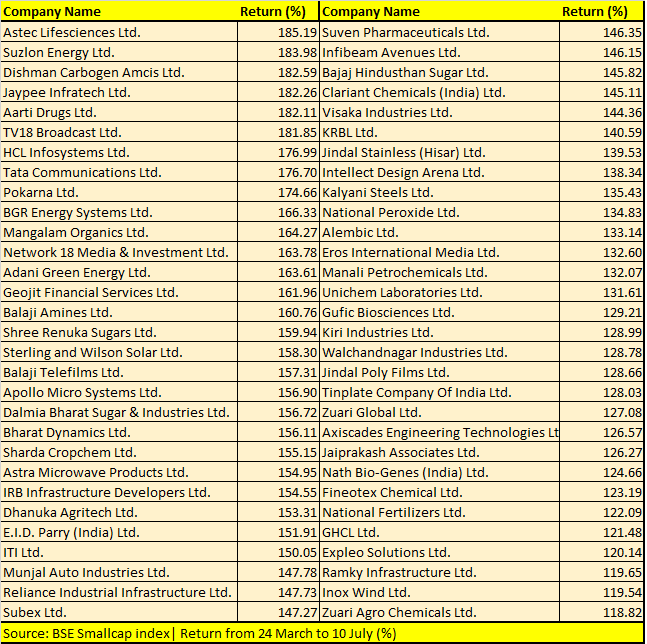
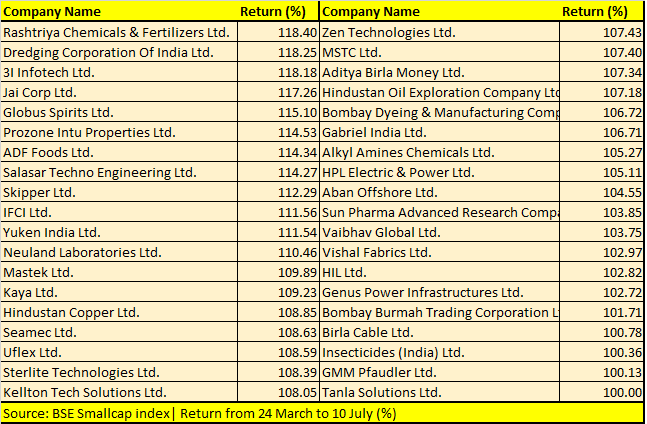
Unwanted and ignored for two years, they have become the darling of the market over the last three months. The S&P BSE Smallcap index has vaulted 44 percent since March 24, when the benchmark indices hit their intermediate bottom, and more than 100 stocks have rallied over 100-800 percent during the period.
The rally in the smallcap space has been fast and furious. While many have stayed on the sidelines, several millennials as well as institutional investors have taken advantage of the volatility.
The S&P BSE Smallcap index has rallied by about 44 percent compared to 35 percent rally seen in the S&P BSE Midcap index. The S&P BSE Sensex has risen 37 percent while the Nifty50 is up 38 percent from March 24 lows.
Opto Circuits, Sintex Plastics, Reliance Power, IOL Chemicals, GTL Infrastructure and Reliance Home Finance are among 123 BSE Smallcap index stocks that have more than doubled investors’ money during the period.
Smallcap 13 1


Smallcap 13 2


Smallcap 13 3

“We believe that the rally in the broader markets is a function of both institutional and retail interest. Given that the economy is on a mend, we are seeing increased investor interest in mid and smallcaps, given the beaten-down valuations that are driving the rally in broader markets,” Jyoti Roy, DVP Equity Strategist, Angel Broking Ltd, told Moneycontrol.
“While the rally so far has been driven by improving economic activity and liquidity, there one can build a case that the FOMO factor could be creeping into the markets, which may drive markets higher from current levels if global markets remain supportive,” he said, referring to the acronym for “fear of losing out”.
The mid and smallcaps have been in a correction since January 2018, when both the Nifty Midcap 100 and the Smallcap100 indices hit lifetime highs.
Since then, the midcap index has plunged 30 percent and the smallcap 50 percent as compared to the Nifty, which is trading lower in a single digit from its January 2018 levels.
“If you see, the smallcap index had a great 2017 and then everybody went into 2018 expecting a repeat. We all know how terrible 2018 turned out to be for smallcaps. Even 2019 was a poor year and then came 2020 March. At the lows of March 2020, the smallcap index had fallen nearly 50 percent from its highs of 2017,” said Shankar Sharma, co-founder, and vice-chairman, First Global.
“When and the index falls so much then you can take a reasonably calculated bet that it is going to outperform for the next few months, which is exactly what is happening.
What also happened in the last three years is that any number of smallcap companies became extremely undervalued. Most had been delivering decent performance but the market was not interested,” he said.
DisclaimerThe views and investment tips expressed by experts on Moneycontrol.com are their own and not those of the website or its management. Moneycontrol.com advises users to check with certified experts before taking any investment decisions.
First Published on Jul 14, 2020 10:00 am
Last Updated : Jul 14, 2020 11:27 AM IST | Source: Moneycontrol.com

Biocon to launch COVID-19 drug; stock jumps 5%

Biocon said the approval of Itolizumab, from the DCGI, is based on the results from the successful conclusion of a randomized, controlled clinical trial at multiple hospitals in Mumbai and New Delhi.

Moneycontrol News @moneycontrolcom
 
 
NSELIVE
14 Jul, 2020 11:44
429.85  
15.00 (3.62%)
Volume 14025765
Todays L/H 417.00435.50
More 
Shares of Biocon jumped almost 5 percent intraday on July 14 after the company said it will launch biologic drug Itolizumab for the treatment of moderate to severe COVID-19 patients at a price of around Rs 8,000 per vial.
The company has received approval from the Drugs Controller General of India (DCGI) to market Itolizumab injection 25mg/5mL solution for emergency use in India for the treatment of cytokine release syndrome in moderate to severe acute respiratory distress syndrome (ARDS) due to COVID-19.
Itolizumab will be manufactured and formulated as an intravenous injection at Biocon’s bio-manufacturing facility at Biocon Park, Bengaluru, said the company.
Biocon said the approval of Itolizumab, from the DCGI, is based on the results from the successful conclusion of a randomized, controlled clinical trial at multiple hospitals in Mumbai and New Delhi.
The study focussed on the safety and efficacy of Itolizumab in preventing CRS in moderate to severe ARDS patients due to COVID-19. The primary endpoints for the reduction in mortality rate were met and other key secondary endpoints for efficacy and biomarkers were also achieved, the company said.
“Itolizumab’s unique mechanism of action made it an ideal candidate for treating the ‘cytokine storm’, which is a leading cause of death in COVID-19 patients. I am pleased that our R&D and clinical teams delivered on this promising hypothesis in such a short period of time. It is a proud moment for all of us at Biocon and we would like more and more patients to benefit from this therapy," said Kiran Mazumdar-Shaw, Executive Chairperson, Biocon.
Shares of the company traded 3.17 percent up at Rs 427.75 on BSE around 11:10 hours. If the stock ends in the green, it will be its fifth consecutive session of gains.
First Published on Jul 14, 2020 11:27 am
Last Updated : Jul 14, 2020 11:23 AM IST | Source: Moneycontrol.com

Robinhood raises another $320 million, increasing its valuation to $8.6 billion

The additional money comes from investors like TSG Consumer Partners and IVP, helping Robinhood raise a total of USD 600 million in its seed round within two months.

Moneycontrol News @moneycontrolcom
US-based financial services company Robinhood said that it has raised an additional USD 320 million more to the previously-raised USD 280 million in its Series F funding round. The amount was raised at a total valuation of USD 8.6 million.
The additional money comes from investors like TSG Consumer Partners and IVP, helping Robinhood raise a total of USD 600 million in its seed round within two months.
Prior to the latest funding, Robinhood had announced in May that it had raised a total of USD 280 million, making the fintech company worth USD 8.3 million, reported TechCrunch.
The funding round is widely being seen as a precursor to an initial public offering (IPO), which has benefited from a surge in day trading, driven by consumers stuck at home during the coronavirus pandemic.
Robinhood has been a hit since its launch in 2015. The firm has reportedly added millions of funded accounts in 2020, as investors of all sizes take part in the year’s huge equity volatility due to the COVID-19 pandemic. 
However, the Menlo Park, California-based startup has also experienced several outages on its app since early March, particularly on days of high trading volumes.
First Published on Jul 14, 2020 11:23 am
Last Updated : Jul 14, 2020 11:11 AM IST | Source: PTI

Cipla gets USFDA nod for rare genetic condition treatment drug

Cipla's Icatibant injectable pre-filled syringe in the strength of 30mg/3mL is generic version of Shire's Firazyr, the company said in a regulatory filing.

PTI
Representative image
 
 
NSELIVE
14 Jul, 2020 11:44
639.00  
0.65 (0.10%)
Volume 3069318
Todays L/H 636.85644.00
More 
Drug major Cipla on Tuesday said that it has received final approval from the United States Food and Drug Administration (USFDA) for Icatibant Injectable, indicated for treatment of acute attacks of hereditary angioedema - a rare genetic condition - in adults.
Cipla's Icatibant injectable pre-filled syringe in the strength of 30mg/3mL is generic version of Shire's Firazyr, the company said in a regulatory filing.
The firm said "it has received final approval for its abbreviated new drug application for Icatibant Injectable 30mg/3mL from the United States Food and Drug Administration".
Quoting IQVIA (IMS Health) data, Cipla said Firazyr and its generic equivalents had US sales of approximately USD 270 million for the 12-month period ending May 2020.
Shares of Cipla were trading 0.49 percent higher at Rs 641.25 apiece on the BSE.
First Published on Jul 14, 2020 11:05 am


Smallcap index has rallied about 44 percent and the BSE Midcap index 35 percent since March 24. The Sensex has risen 37 percent and the Nifty 38 percent during the period.
https://www.moneycontrol.com/news/business/markets/fomo-or-value-buying-smallcaps-make-quick-recovery-from-march-24-123-stocks-rise-over-100-5541281.html